
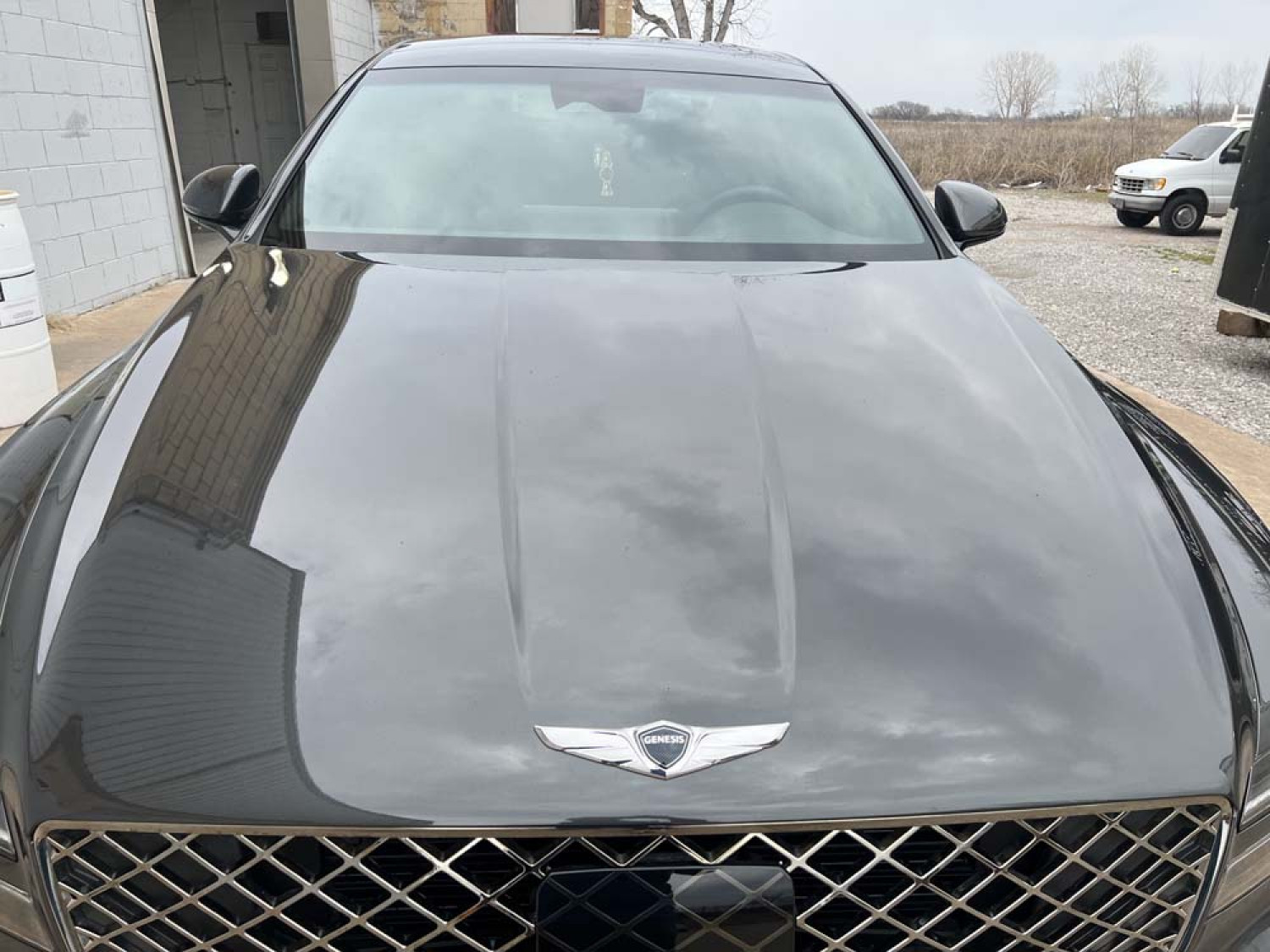
How Scratches Are Reduced or Removed
Scratch removal begins with washing the affected panel to eliminate loose dirt that could cause additional marring during polishing. The area around the scratch is examined under LED lighting to map the defect's depth and determine the appropriate polishing compound and pad combination. A dual-action polisher with a cutting compound removes microns of clear coat in controlled passes, lowering the surrounding surface until it reaches the bottom of the scratch and eliminates the depth differential that causes the line to appear.
After correction, light scratches disappear completely because the clear coat has been leveled to a uniform plane. Moderate scratches become less visible as their edges are softened and their depth is reduced, though a faint trace may remain if the scratch approached the base coat. The polished area is then refined with a finishing polish to remove any haze left by the cutting compound, restoring the paint's gloss and clarity.
Polishing removes material, so repeated scratch removal on the same panel eventually thins the clear coat to a point where further correction risks burning through to the color layer. Protecting corrected paint with ceramic coating or sealant slows the accumulation of new scratches and extends the time between correction services.
What Property Owners Usually Ask
Scratch visibility and removal potential vary based on paint color, lighting conditions, and the angle at which light hits the defect. These answers clarify what to expect from the service.
- How do you know if a scratch can be fully removed or only reduced? Scratches that do not catch a fingernail and appear only as faint lines under direct light can usually be removed completely; scratches that feel like grooves to the touch will be reduced but not eliminated unless they are very shallow.
- What happens if polishing removes too much clear coat during scratch correction? Over-polishing creates a burn-through, where the clear coat is removed entirely and the base color or primer becomes visible as a lighter patch; this cannot be reversed without repainting the panel.
- Can you remove scratches from plastic trim or unpainted surfaces? No, polishing compounds are designed for automotive clear coat and will damage or discolor plastic, rubber, and textured surfaces that lack a painted finish.
- Why do some scratches reappear after correction? If a scratch was only partially leveled, changes in lighting or viewing angle can make it visible again; alternatively, new scratches in the same location may be mistaken for the original defect.
- How does Lawton's climate affect scratch visibility on vehicle paint? Intense sunlight and high UV exposure in Oklahoma highlight scratches by increasing contrast between damaged and undamaged clear coat, making defects more noticeable than in overcast or humid regions.